

Introduction
Financial markets are the backbone of every modern economy. Whether it is an individual saving money, a company raising funds for expansion, or a government financing infrastructure projects, financial markets play a critical role in connecting those who have surplus money with those who need capital.
Imagine a world without financial markets. Businesses would struggle to raise money, investors would have no organized place to invest, and economic growth would slow dramatically. Financial markets create a structured system where savings are converted into productive investments. They help in capital formation, wealth creation, liquidity management, risk transfer, and efficient allocation of resources.
In India, financial markets have evolved significantly over the last few decades. With technological advancements, digital trading platforms, regulatory improvements, and increasing investor participation, the Indian financial market ecosystem has become more transparent and accessible than ever before.
This chapter explains:
- The ecosystem of financial markets
- Primary and secondary markets
- Participants in securities markets
- The functioning and importance of financial systems
- The role of regulators and intermediaries
- How investors and companies interact within markets
Understanding these concepts is essential for anyone pursuing careers in finance, investment banking, equity research, wealth management, stock trading, or financial analysis.
1. Understanding Financial Markets
A financial market is a marketplace where buyers and sellers participate in the trading of financial assets such as:
- Stocks
- Bonds
- Debentures
- Mutual funds
- Derivatives
- Commodities
- Currencies
The primary objective of financial markets is to facilitate the efficient flow of funds in the economy.
Definition of Financial Markets
Financial markets are organized platforms where financial securities are issued, bought, sold, and traded between investors and institutions.
These markets help channel savings into productive investments.
2. Importance of Financial Markets
Financial markets perform several essential functions in the economy.
a) Capital Formation
Companies raise funds for:
- Expansion
- Modernization
- New projects
- Acquisitions
Without financial markets, businesses would rely only on bank loans.
b) Mobilization of Savings
Financial markets encourage individuals to save and invest money instead of keeping idle cash.
Savings flow into:
- Equity markets
- Debt instruments
- Mutual funds
- Government securities
c) Liquidity
Liquidity means the ease with which an asset can be converted into cash.
Stock exchanges provide liquidity because investors can buy and sell securities quickly.
d) Price Discovery
Prices of securities are determined by:
- Demand
- Supply
- Market sentiment
- Economic conditions
- Company performance
This process is known as price discovery.
e) Economic Growth
Efficient financial markets support:
- Industrial growth
- Infrastructure development
- Employment generation
- Innovation
Countries with strong financial systems generally experience faster economic development.
3. Ecosystem of Financial Markets
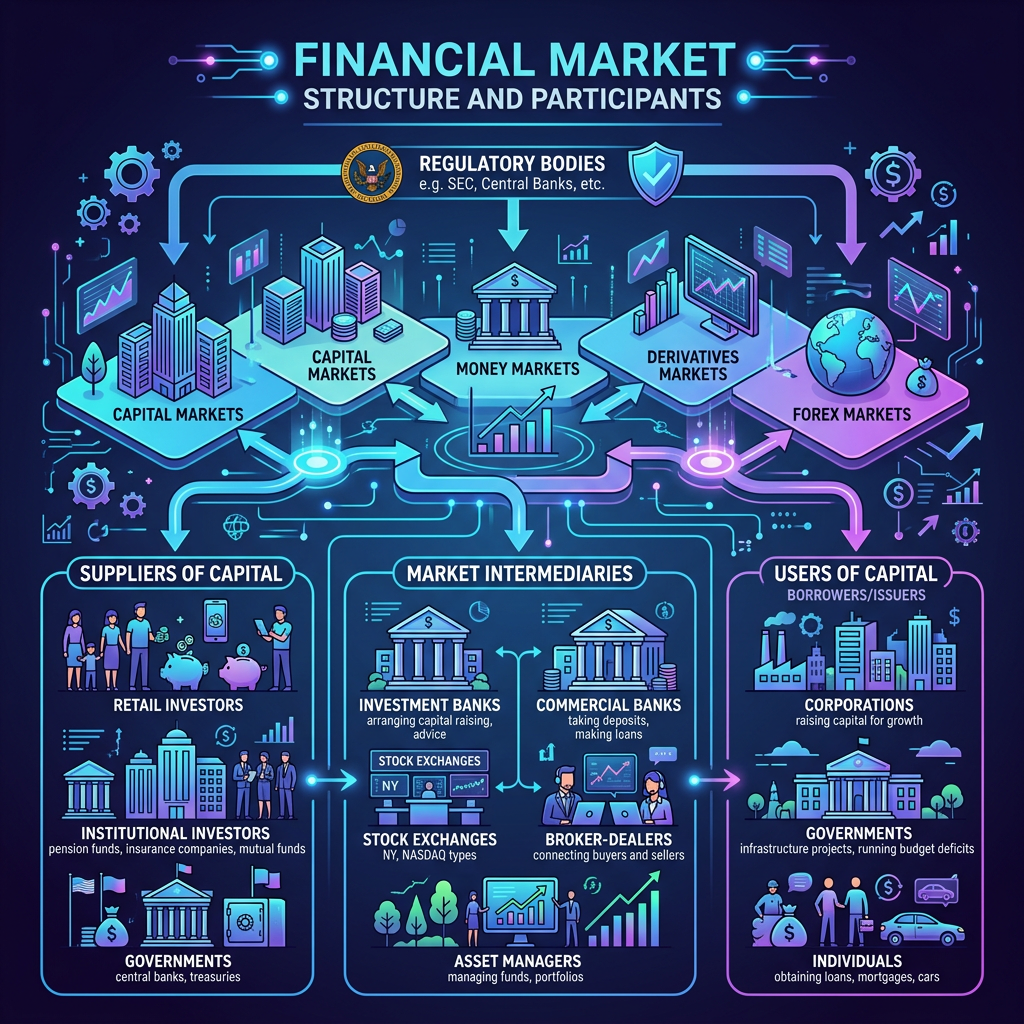
The financial market ecosystem consists of multiple participants, institutions, intermediaries, regulators, and instruments working together to ensure smooth market functioning.
Components of Financial Market Ecosystem
The ecosystem includes:
| Component | Role |
|---|---|
| Investors | Provide capital |
| Companies | Raise funds |
| Stock Exchanges | Provide trading platform |
| Regulators | Ensure transparency |
| Brokers | Facilitate transactions |
| Depositories | Hold securities electronically |
| Banks | Support fund transfers |
| Mutual Funds | Pool investor money |
| Credit Rating Agencies | Assess creditworthiness |
4. Structure of Financial Markets
Financial markets can broadly be divided into:
a) Money Market
Deals in short-term instruments with maturity less than one year.
Examples:
- Treasury Bills
- Commercial Papers
- Certificates of Deposit
Features
- High liquidity
- Low risk
- Short-term borrowing
b) Capital Market
Deals in long-term securities.
Examples:
- Shares
- Bonds
- Debentures
Capital markets are further classified into:
- Primary Market
- Secondary Market
5. What is the Primary Market?
The primary market is the market where new securities are issued for the first time.
Companies raise fresh capital from investors through the primary market.
Definition
The primary market is a market where securities are issued directly by companies to investors.
6. Features of Primary Market
a) New Issue Market
Securities are sold for the first time.
b) Direct Fund Raising
Money goes directly to the issuing company.
c) Helps in Capital Formation
Companies use funds for:
- Business expansion
- Debt repayment
- Working capital
- New projects
d) Regulated Process
Primary market activities are regulated by:
- Securities and Exchange Board of India (SEBI)
- Stock exchanges
- Merchant bankers
7. Methods of Issuing Securities in Primary Market
a) Initial Public Offering (IPO)
An IPO occurs when a private company offers shares to the public for the first time.
Example:
A startup becomes a publicly listed company through an IPO.
Advantages
- Raises large capital
- Improves brand visibility
- Enhances credibility
b) Follow-on Public Offer (FPO)
A listed company issues additional shares after IPO.
Purpose:
- Expansion
- Debt reduction
- Acquisitions
c) Rights Issue
Existing shareholders receive the right to buy additional shares at a discounted price.
d) Bonus Issue
Free shares are issued to existing shareholders from company reserves.
e) Private Placement
Securities are sold to selected investors instead of the public.
Usually subscribed by:
- Institutions
- Banks
- High-net-worth individuals
8. Process of IPO in India
The IPO process involves multiple stages.
Step 1: Appointment of Merchant Banker
The company appoints investment banks to manage the issue.
Step 2: Draft Red Herring Prospectus (DRHP)
The company files DRHP with:
- SEBI
- Stock exchanges
It contains:
- Financial statements
- Risks
- Business details
- Management information
Step 3: SEBI Approval
SEBI reviews the issue to ensure compliance.
Step 4: Roadshows and Marketing
The company promotes the IPO to institutional and retail investors.
Step 5: Price Determination
IPO price may be:
- Fixed price
- Book-building price
Step 6: Subscription
Investors apply for shares through:
- Banks
- Trading platforms
- ASBA facility
Step 7: Allotment and Listing
Shares are allotted and listed on stock exchanges.
9. What is Secondary Market?
The secondary market is where existing securities are traded among investors.
Companies do not receive money in secondary market transactions.
Definition
The secondary market is a market where already-issued securities are bought and sold among investors.
10. Features of Secondary Market
a) Liquidity
Investors can easily buy and sell securities.
b) Continuous Trading
Trading occurs daily during market hours.
c) Price Discovery
Prices fluctuate based on:
- Company performance
- Market demand
- Economic factors
d) Investor Participation
Retail and institutional investors actively trade securities.
11. Importance of Secondary Market
a) Provides Exit Opportunity
Investors can sell securities whenever required.
b) Encourages Investment
People invest confidently because liquidity is available.
c) Reflects Economic Conditions
Stock market performance often indicates economic health.
d) Wealth Creation
Long-term investing in equities helps create wealth.
12. Difference Between Primary Market and Secondary Market
| Basis | Primary Market | Secondary Market |
|---|---|---|
| Meaning | New securities issued | Existing securities traded |
| Fund Flow | To company | Between investors |
| Purpose | Capital raising | Liquidity |
| Price Determination | Fixed or book building | Demand and supply |
| Example | IPO | Stock exchange trading |
13. Stock Exchanges in India
Stock exchanges provide organized trading platforms.
Major Indian stock exchanges include:
a) National Stock Exchange (NSE)
India’s largest stock exchange by trading volume.
Key index:
- Nifty 50
b) Bombay Stock Exchange (BSE)
Asia’s oldest stock exchange.
Key index:
- Sensex
14. Role of Stock Exchanges
Stock exchanges perform critical functions.
a) Facilitate Trading
Provide electronic trading platforms.
b) Ensure Transparency
Trading systems ensure fair pricing.
c) Investor Protection
Exchanges monitor market activities.
d) Settlement Mechanism
Ensure smooth transfer of funds and securities.
15. Depositories and Demat System
Earlier, shares were held in physical form.
Now, securities are held electronically in demat accounts.
Major Depositories in India
a) National Securities Depository Limited (NSDL)
b) Central Depository Services Limited (CDSL)
16. What is a Demat Account?
A Demat account stores securities electronically.
It functions similarly to a bank account but stores shares instead of money.
Benefits
- Eliminates paper certificates
- Reduces fraud
- Faster settlements
- Convenient trading
17. Trading Account vs Demat Account
| Feature | Trading Account | Demat Account |
|---|---|---|
| Purpose | Buying/selling shares | Holding shares |
| Function | Transaction execution | Storage |
| Managed by | Broker | Depository participant |
18. Market Intermediaries
Market intermediaries facilitate smooth market operations.
Types of Intermediaries
a) Stock Brokers
Execute buy and sell orders.
Examples include brokerage firms and online trading platforms.
b) Merchant Bankers
Manage IPOs and capital raising activities.
c) Registrars and Transfer Agents (RTAs)
Handle:
- Shareholder records
- Allotments
- Transfers
d) Depository Participants (DPs)
Agents of depositories providing demat services.
e) Mutual Fund Companies
Pool money from investors and invest professionally.
19. Mutual Funds and Financial Markets
Mutual funds are important institutional participants.
Advantages
- Professional management
- Diversification
- Liquidity
- Affordable investing
Types include:
- Equity funds
- Debt funds
- Hybrid funds
- Index funds
20. Role of SEBI
Securities and Exchange Board of India is the regulator of Indian securities markets.
Established in:
- 1988
- Statutory powers in 1992
21. Objectives of SEBI
a) Protect Investors
Prevent fraud and manipulation.
b) Promote Market Development
Encourage fair and efficient markets.
c) Regulate Intermediaries
Monitor brokers, merchant bankers, and exchanges.
22. Functions of SEBI
| Function | Description |
|---|---|
| Regulatory | Market supervision |
| Developmental | Investor education |
| Protective | Prevent unfair practices |
23. Participants in Securities Markets
Financial markets involve various participants with different objectives.
24. Retail Investors
Individual investors who buy and sell securities for personal investment.
Characteristics
- Smaller investment size
- Long-term or short-term investing
- Growing participation via digital platforms
25. Institutional Investors
Large organizations investing significant funds.
Examples:
- Insurance companies
- Pension funds
- Mutual funds
- Banks
26. Foreign Portfolio Investors (FPIs)
Foreign investors investing in Indian securities markets.
They significantly influence:
- Liquidity
- Market sentiment
- Capital inflows
27. Domestic Institutional Investors (DIIs)
Indian institutions investing in financial markets.
Examples:
- Mutual funds
- Insurance companies
DIIs often stabilize markets during volatility.
28. Traders and Speculators
Traders aim to profit from short-term price movements.
Types
- Intraday traders
- Swing traders
- Derivatives traders
29. Hedgers
Hedgers reduce financial risk using derivatives.
Example:
An exporter hedging currency risk.
30. Arbitrageurs
Arbitrageurs profit from price differences in different markets.
They improve market efficiency.
31. Market Makers
Market makers provide liquidity by continuously quoting buy and sell prices.
They help reduce bid-ask spreads.
32. Credit Rating Agencies
These agencies evaluate creditworthiness of debt instruments.
Major Indian agencies include:
- CRISIL
- ICRA
- CARE Ratings
33. Financial Instruments in Securities Markets
a) Equity Shares
Represent ownership in a company.
Benefits:
- Dividends
- Capital appreciation
b) Preference Shares
Provide fixed dividends with preferential rights.
c) Bonds and Debentures
Debt instruments issued by companies and governments.
d) Derivatives
Contracts derived from underlying assets.
Examples:
- Futures
- Options
34. Market Indices
Market indices measure overall market performance.
Major Indian Indices
a) Nifty 50
Represents top companies listed on NSE.
b) Sensex
Represents major companies listed on BSE.
35. Trading and Settlement Process
Trading Cycle
Step 1: Order Placement
Investor places order through broker.
Step 2: Order Matching
Exchange matches buy and sell orders.
Step 3: Trade Execution
Transaction gets executed.
Step 4: Clearing and Settlement
Funds and securities are transferred.
India follows:
- T+1 settlement cycle
Meaning:
- Settlement occurs one business day after trade date.
36. Clearing Corporations
Clearing corporations guarantee settlement of trades.
Functions include:
- Risk management
- Settlement assurance
- Margin collection
37. Risks in Financial Markets
Investing involves risks.
a) Market Risk
Risk due to market fluctuations.
b) Credit Risk
Risk of default by borrowers.
c) Liquidity Risk
Difficulty in selling assets quickly.
d) Interest Rate Risk
Impact of changing interest rates.
e) Inflation Risk
Reduction in purchasing power.
38. Technology and Financial Markets
Technology transformed financial markets significantly.
Key Developments
- Online trading
- Mobile investing apps
- Algorithmic trading
- Digital KYC
- UPI-based IPO applications
39. Role of Financial Markets in Economic Development
Financial markets support:
- Entrepreneurship
- Industrial growth
- Infrastructure financing
- Employment creation
- Innovation
Efficient markets improve allocation of resources and economic productivity.
40. Financial Inclusion and Investor Awareness
Financial literacy is becoming increasingly important.
Investor awareness helps individuals:
- Avoid frauds
- Make informed decisions
- Build wealth responsibly
Government and regulators conduct:
- Investor education programs
- Awareness campaigns
- Financial literacy initiatives
41. Challenges Faced by Financial Markets
a) Market Volatility
Frequent price fluctuations create uncertainty.
b) Fraud and Manipulation
Insider trading and scams affect investor confidence.
c) Cybersecurity Risks
Digital trading platforms face cyber threats.
d) Global Economic Uncertainty
International events impact domestic markets.
42. Future of Financial Markets in India
India’s financial markets are expected to grow rapidly because of:
- Increasing retail participation
- Digital adoption
- Economic expansion
- Rising financial awareness
- Growth of mutual funds
Emerging trends include:
- Artificial intelligence in trading
- ESG investing
- Fintech innovation
- Blockchain technology
43. Practical Example of Financial Market Functioning
Consider the following example:
A company wants to build a manufacturing plant worth ₹500 crore.
Step 1: Raising Capital
The company launches an IPO in the primary market.
Investors subscribe to shares.
Step 2: Listing on Exchange
Shares are listed on NSE and BSE.
Step 3: Secondary Market Trading
Investors buy and sell shares daily.
Step 4: Wealth Creation
If the company performs well:
- Share prices rise
- Investors gain returns
This demonstrates how financial markets connect savings with productive economic activity.
44. Importance for Students and Finance Professionals
Understanding financial markets is essential for careers in:
- Investment banking
- Equity research
- Wealth management
- Portfolio management
- Risk management
- Trading
- Corporate finance
Professional certifications such as:
- CFA
- FRM
- NISM
- NCFM
all require strong understanding of financial markets.
Conclusion
Financial markets are essential pillars of economic development and wealth creation. They provide a structured framework where capital flows from investors to businesses and governments. The ecosystem of financial markets includes regulators, exchanges, brokers, depositories, institutional investors, and retail participants working together to ensure efficient functioning.
The primary market helps companies raise fresh capital, while the secondary market provides liquidity and trading opportunities for investors. Participants in securities markets range from retail investors to large institutional players, each contributing to market depth and efficiency.
In India, financial markets have evolved into highly sophisticated systems supported by technology, regulation, and increasing investor awareness. Institutions such as Securities and Exchange Board of India, National Stock Exchange, and Bombay Stock Exchange have played crucial roles in strengthening market infrastructure and investor confidence.
As financial literacy and digital adoption continue to increase, financial markets will remain central to India’s economic growth story. For students, professionals, and investors, understanding how financial markets function is not just academically important—it is essential for making informed financial and investment decisions in the modern economy.
Leave a Reply